What Is Organic Pickle and How Is It Different from Regular Pickle?
Pickles have been an important part of Indian food culture for generations. From spicy mango achaar with dal and rice to green chilli pickle with paratha, a small serving of pickle can make an everyday meal much more flavourful.
Today, many people are becoming more conscious about what they eat and are searching for options made with quality ingredients. This has increased interest in organic pickles and traditional homemade-style pickles.
But what exactly is an organic pickle? How is it different from a regular pickle? And what should you look for when buying one?
In this guide, we will explain everything you need to know about organic pickles and help you understand how they compare with regular pickles.
If you’re looking for homemade pickles from Rasoi Achaar, you can also explore our collection of traditional Indian pickle varieties.
What Is an Organic Pickle?
An organic pickle is generally made using ingredients that are certified organic according to the applicable organic standards. This may include organically grown fruits, vegetables, spices and other agricultural ingredients.
For example, an organic mango pickle may use organically grown mangoes and spices, depending on the product and its certification.
However, it is important to understand that simply calling a pickle “natural,” “homemade,” or “chemical-free” does not automatically make it certified organic.
When buying an organic pickle, consumers should check the product packaging and certification information to understand what ingredients are actually certified organic.
What Makes Organic Pickles Different?
The biggest difference between organic and regular pickles is generally related to the source and production standards of the ingredients, rather than the basic idea of pickling itself.
Traditional pickling commonly uses ingredients such as:
Fresh fruits or vegetables
Spices
Salt
Oil
Natural acids such as vinegar or the acids produced during fermentation
An organic version may use ingredients sourced according to organic farming standards.
This means the word “organic” should be evaluated based on the actual ingredients, certification and manufacturing practices rather than the appearance or taste of the pickle alone.
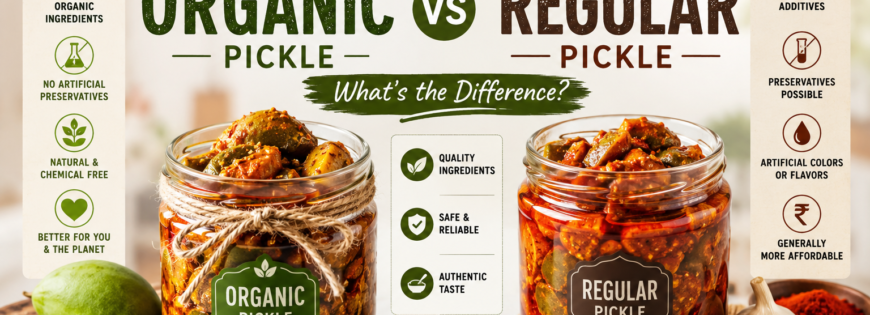
Organic Pickle vs Regular Pickle
Let’s look at some important differences.
| Feature | Organic Pickle | Regular Pickle |
|---|---|---|
| Ingredient sourcing | May use certified organic ingredients | May use conventionally grown ingredients |
| Farming practices | Organic standards may apply | Conventional farming practices may be used |
| Certification | Certified products carry relevant certification | Certification may not be applicable |
| Taste | Can have a traditional, natural flavour | Taste varies by recipe and brand |
| Ingredients | Depends on the product | Depends on the product |
| Preservatives | Depends on formulation | Depends on formulation |
| Price | Often higher due to sourcing and certification | Can be more economical |
| Recipe | Can follow traditional recipes | Can follow traditional or commercial recipes |
It is important to remember that regular does not automatically mean unhealthy, and organic does not automatically mean every other aspect of a product is better.
The right choice depends on your preferences, ingredients, dietary requirements and what you value when purchasing food.
Is Homemade Pickle the Same as Organic Pickle?
No.
This is one of the most common misunderstandings.
A homemade pickle describes how or where a pickle is prepared, while organic pickle refers primarily to the sourcing and standards of the ingredients and, where applicable, organic certification.
For example, someone could prepare a pickle at home using conventionally grown mangoes and spices. It could be homemade but not certified organic.
Similarly, an organic pickle can be commercially produced using certified organic ingredients and appropriate production standards.
Therefore:
Homemade ≠ automatically organic
and
Organic ≠ automatically homemade.
If you enjoy the traditional taste of homemade-style achaar, explore Rasoi Achaar’s traditional pickle collection.
Are Organic Pickles Healthier?
This question needs a little care.
Organic certification primarily relates to how agricultural ingredients are produced and handled according to applicable organic standards. It does not automatically mean that an organic pickle is a low-salt, low-oil or low-calorie food.
Pickles can contain significant amounts of salt and, depending on the recipe, oil.
Therefore, if you’re choosing a pickle for health or dietary reasons, look beyond the word “organic” and check:
Ingredient list
Salt content
Oil used
Serving size
Added ingredients
Sugar content, if applicable
Certification information
A balanced diet and sensible portion sizes are important regardless of whether a pickle is organic or regular.
Why Do People Choose Organic Pickles?
There are several reasons consumers may prefer organic products.
1. Ingredient Sourcing
Some consumers prefer ingredients grown according to organic farming standards.
2. Greater Ingredient Awareness
People who carefully read food labels may prefer products with clear ingredient information and recognised certifications.
3. Traditional Food Preferences
Many consumers interested in organic foods are also interested in traditional food preparation methods and regional recipes.
4. Personal Lifestyle Choices
Choosing organic food can be part of a broader lifestyle preference focused on organic farming and ingredient sourcing.
What About Preservatives?
Another common misconception is:
“Organic pickle means it contains no preservatives.”
This is not necessarily true.
Organic certification and preservative use are separate questions. A product may be organic while still using ingredients or processing methods permitted under the applicable standards.
Likewise, a non-organic pickle may be made without artificial preservatives.
If avoiding specific preservatives is important to you, always read the ingredient label rather than assuming based on the word “organic.”
At Rasoi Achaar, customers can check the available product information for individual pickle varieties before ordering.
How Are Traditional Indian Pickles Made?
Indian pickling traditions vary significantly from region to region.
A traditional pickle may begin with fresh fruits or vegetables, which are combined with spices, salt and oil or another suitable pickling medium.
Different regions use different combinations of ingredients.
For example, mango pickle commonly uses spices and oil to create its characteristic spicy and tangy flavour.
Green chilli pickle is popular among people who enjoy a stronger spicy kick.
Jackfruit pickle, also known as kathal achaar, offers a distinctive flavour and texture.
Bitter gourd pickle, or karela achaar, is another traditional variety appreciated by people who enjoy bold flavours.
You can discover these and other varieties in the Rasoi Achaar pickle range.
How to Choose a Good Organic Pickle
If you want to buy organic pickle, don’t choose only based on the word “organic” on the front of the package.
Consider these factors.
Check the Certification
If a product claims to be certified organic, look for the relevant certification or regulatory information on the packaging.
Read the Ingredient List
Check what the pickle actually contains. Look for the primary fruit or vegetable, spices, oil, salt and any other ingredients.
Check the Nutrition Information
Pay attention to serving size, sodium/salt, calories and other information relevant to your dietary needs.
Consider the Flavour
A premium pickle should also be enjoyable. Choose flavours that match your meals and spice preference.
Buy From a Trusted Brand
Choose a seller that clearly communicates its ingredients, product information and storage instructions.
Organic Mango Pickle – A Popular Choice
Among Indian pickle varieties, mango pickle remains a favourite.
Its combination of tangy raw mango, spices and traditional pickle flavours makes it suitable for many everyday meals.
If you’re specifically looking for mango pickle online, Rasoi Achaar offers a convenient way to explore mango-based pickle options.
Mango pickle can be enjoyed with:
Dal and rice
Paratha
Curd rice
Khichdi
Roti
Biryani
Dosa
The best combination ultimately depends on your personal taste.
Organic Pickles for Modern Indian Families
Modern families are increasingly looking at ingredient labels and trying to understand where their food comes from.
At the same time, traditional Indian flavours remain an important part of everyday meals.
This is where quality pickle products can bring together traditional recipes and modern convenience.
Instead of preparing pickle at home every season, families can explore different varieties online and choose products that match their ingredient and flavour preferences.
For Bangalore customers looking for convenient options, you can explore homemade pickles in Bangalore from Rasoi Achaar.
Organic Pickles for Working Professionals and Students
Bangalore’s busy lifestyle means many people don’t have the time to prepare traditional food accompaniments at home.
Working professionals, students and PG residents often look for simple ways to make everyday meals more enjoyable.
A jar of pickle can be paired with rice, paratha, curd rice, dosa or other meals without requiring additional preparation.
If you’re looking for convenient options, visit our pickles available online and explore the available flavours.
Are Organic Pickles More Expensive?
Organic pickles can sometimes cost more than conventional products.
This may be due to factors such as:
Organic ingredient sourcing
Certification costs
Farming practices
Ingredient availability
Production methods
Packaging
Smaller production volumes
However, price alone does not determine quality.
When comparing two products, look at the ingredients, quantity, certification, manufacturing information and overall product value.
Organic vs Homemade vs Traditional Pickle: What’s the Difference?
These terms can sometimes be confusing.
Organic Pickle
Refers to the use of ingredients produced according to recognised organic standards, where applicable.
Homemade Pickle
Refers to preparation in a home or homemade-style production environment. It does not automatically mean the ingredients are organic.
Traditional Pickle
Usually refers to a recipe or preparation style connected to regional or cultural food traditions.
A pickle can potentially be traditional, homemade-style and organic, but these terms describe different characteristics.
Why Rasoi Achaar?
At Rasoi Achaar, our focus is on bringing the familiar taste of traditional Indian achaar to modern households.
We believe pickle is more than just a side dish. It is a part of Indian food culture and is often connected with family recipes, regional traditions and memories of home-cooked meals.
Our range includes different flavours for people who enjoy everything from classic mango pickle to more distinctive varieties.
Whether you’re looking for mango pickle, jackfruit pickle, bitter gourd pickle or green chilli pickle, explore the Rasoi Achaar collection and choose a flavour that suits your meals.
Final Thoughts
So, what is the difference between an organic pickle and a regular pickle?
The key difference is generally the sourcing and standards applied to the ingredients, particularly when a product is certified organic.
However, organic does not automatically mean homemade, preservative-free, low-salt or healthier in every respect.
The best way to choose a pickle is to look at the complete picture: ingredients, certification, nutrition information, preparation methods, flavour and your personal preferences.
If you love traditional Indian flavours and want to explore delicious achaar varieties, Rasoi Achaar makes it easy to discover pickle options online.
Explore Rasoi Achaar today and bring the traditional taste of Indian achaar to your everyday meals.
Frequently Asked Questions
What is an organic pickle?
An organic pickle is made using ingredients produced according to applicable organic standards. Certified organic products should provide relevant certification information.
Is homemade pickle always organic?
No. Homemade refers to how or where the pickle is prepared. The ingredients may or may not be organically produced.
Are organic pickles preservative-free?
Not necessarily. Organic certification and preservative use are different considerations. Always check the product’s ingredient list.
Is organic pickle healthier than regular pickle?
Not automatically. Pickles can contain considerable amounts of salt and oil, regardless of whether they are organic. Check the nutritional information and serving size.
Which organic pickle is best?
There is no single best pickle for everyone. Mango, green chilli, jackfruit and other varieties offer different flavours. Choose according to your taste and dietary preferences.
Where can I buy homemade-style pickles online?
You can explore the Rasoi Achaar pickle collection online and choose from a range of traditional Indian pickle flavours.
SEO Details
Primary Keyword:
Organic Pickle
Secondary Keywords:
Organic Pickles, Organic Pickle vs Regular Pickle, What Is Organic Pickle, Homemade Pickles, Traditional Indian Pickles, Organic Mango Pickle, Healthy Pickles, Buy Organic Pickles Online, Indian Achaar, Homemade Achaar
Bangalore Supporting Keywords:
Organic Pickles Bangalore, Buy Organic Pickles Online Bangalore, Homemade Pickles Bangalore, Pickles Online Bangalore, Traditional Pickles Bangalore, Indian Pickles Bangalore
SEO Title:
What Is Organic Pickle? Organic vs Regular Pickle | Rasoi Achaar
Meta Description:
What is an organic pickle and how is it different from regular pickle? Learn about ingredients, certification, preservatives, taste and how to choose the right pickle.